By Alan M. Petrillo
The folks at Superstition (AZ) Fire & Medical District launched their ambulance replacement program in 2015 with the purchase of five Horton Type 1 rigs and recently received their eighth Horton Type 1 ambulance built to the particular specs Superstition has for the design and outfitting of the patient module.
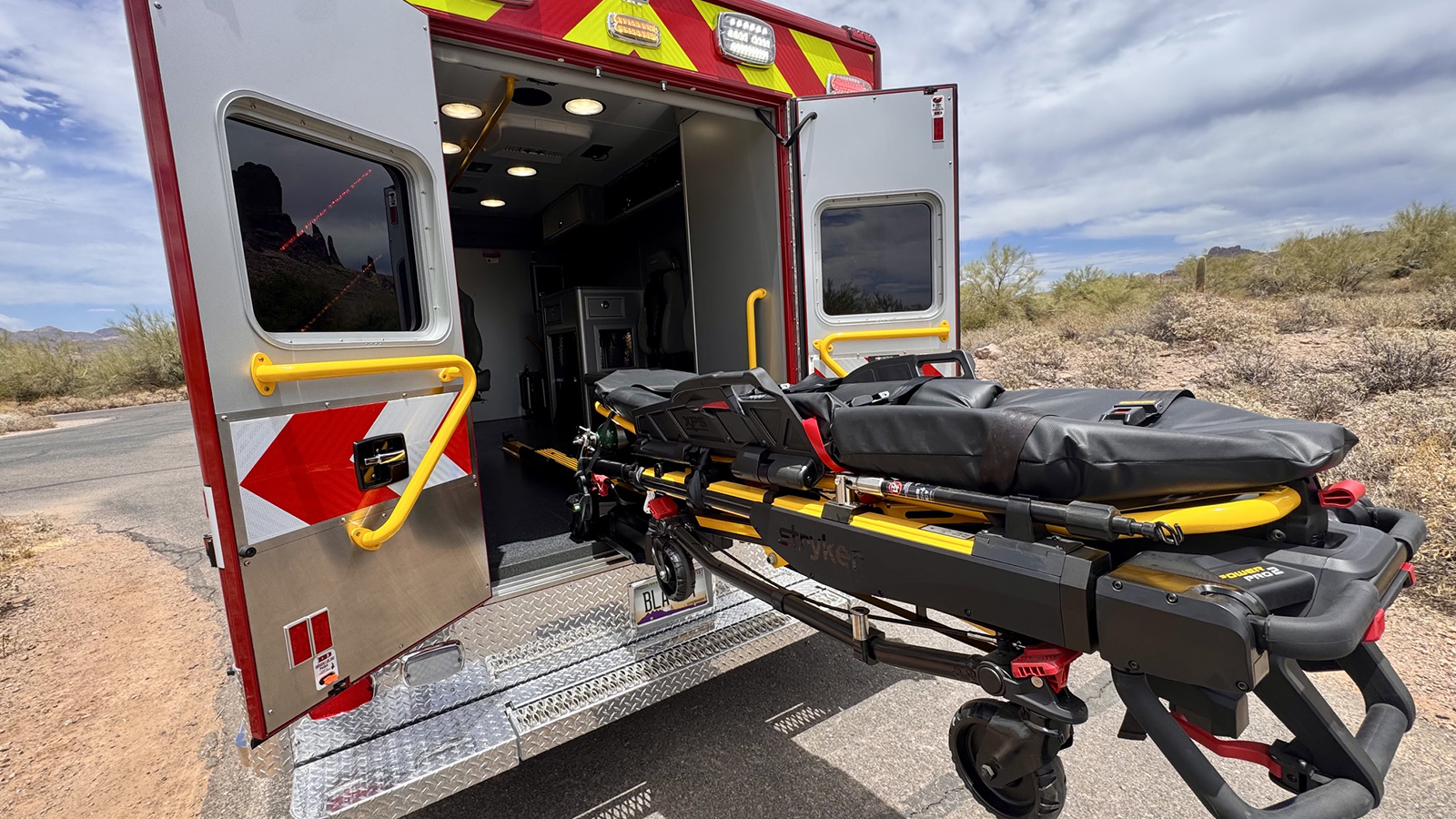
Superstition’s new Horton Type 1 has a Stryker PowerLOAD system and Stryker PowerCOT.
Billy Warren, Superstition Fire & Medical’s director of transport services, says the agency employs 92 full-time paid firefighter/paramedics/emergency medical technicians (EMTs), 24 civilian paramedics/EMTs, and 14 civilian administrative staff operating out of five stations. “We cover 71 square miles and are currently running four front-line Horton advance life support (ALS) Type 1 ambulances, four paramedic engines, one paramedic aerial ladder, and one ladder tender,” Warren observes, “and we are in the process of building our sixth station.”
Dave Marshall, director of sales for Horton Emergency Vehicles, says the newest Horton for Superstition Fire & Medical is a Type 1 built on a Ford F-450 two-door cab and 4×2 chassis with a 193-inch wheelbase, Horton’s 623 model patient module that’s 173 inches long and 96 inches wide, has 74 inches of headroom, and is powered by a 6.7-liter Power Stroke V8 turbo diesel engine, and a TorqShift 10 speed automatic transmission.
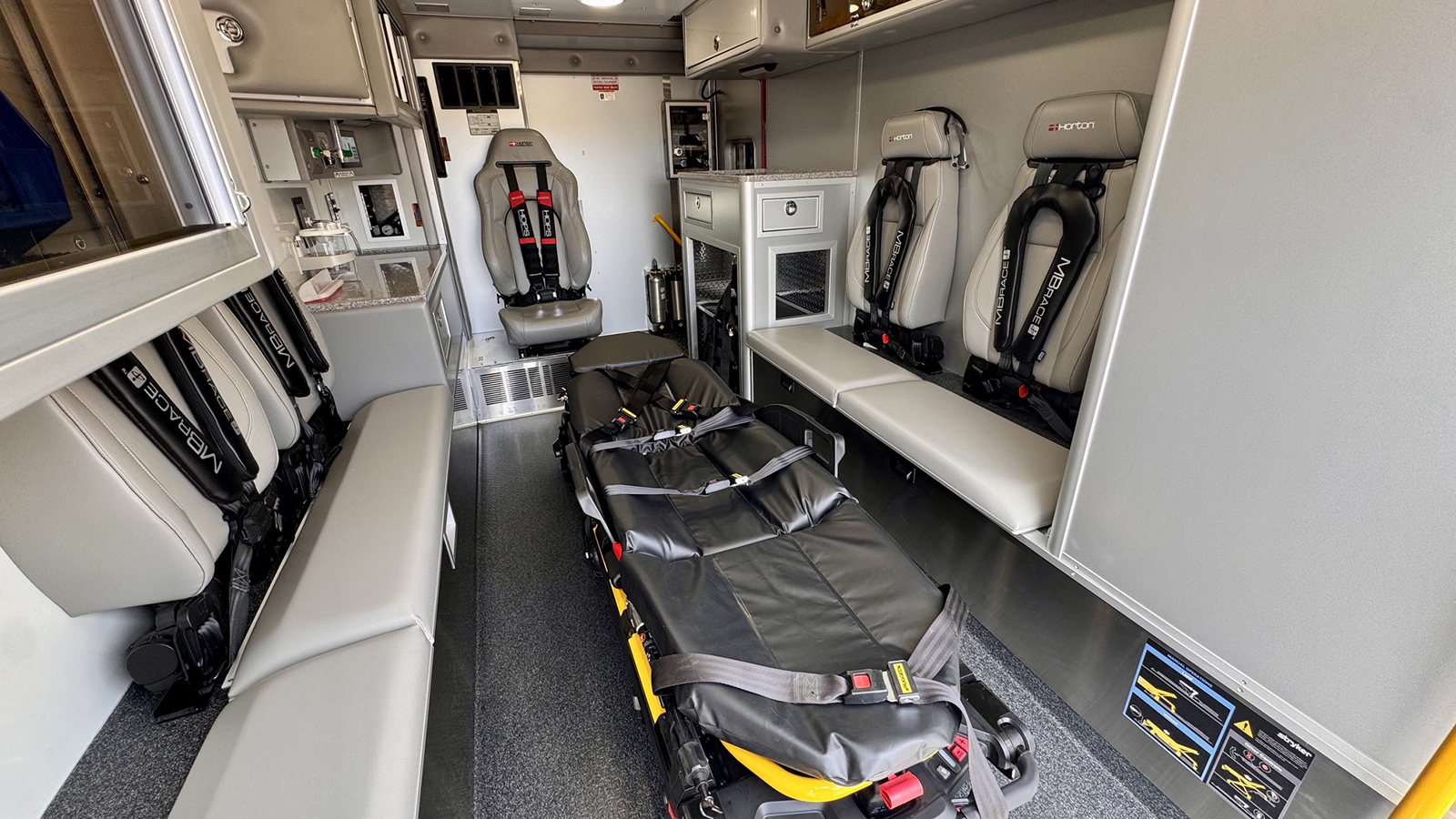
The rig has a total of five seating positions in the patient module, each protected by an MBrace Integrated Harness Airbag system.
Marshall says the new Superstition rig has a LiquidSpring rear suspension; a door-forward design, which Horton designates as a crash barrier safety configuration; a 6-inch drop skirt on the curbside; and a CoolTech II 100,000-British thermal unit (Btu) air conditioning condenser plus a solar panel on the roof.
The rig also has an i4G+ multiplex electrical system with a touchscreen, a Secure Idle system, electric locks for all compartments and entry doors, privacy windows, a 1,100-watt Vanner Lifesine inverter, a Dometic Penguin 110-volt 13,500-Btu secondary air conditioning system on the rooftop to keep the module cool, and two shorelines—one to charge the vehicle’s batteries and the second to power the secondary AC unit.
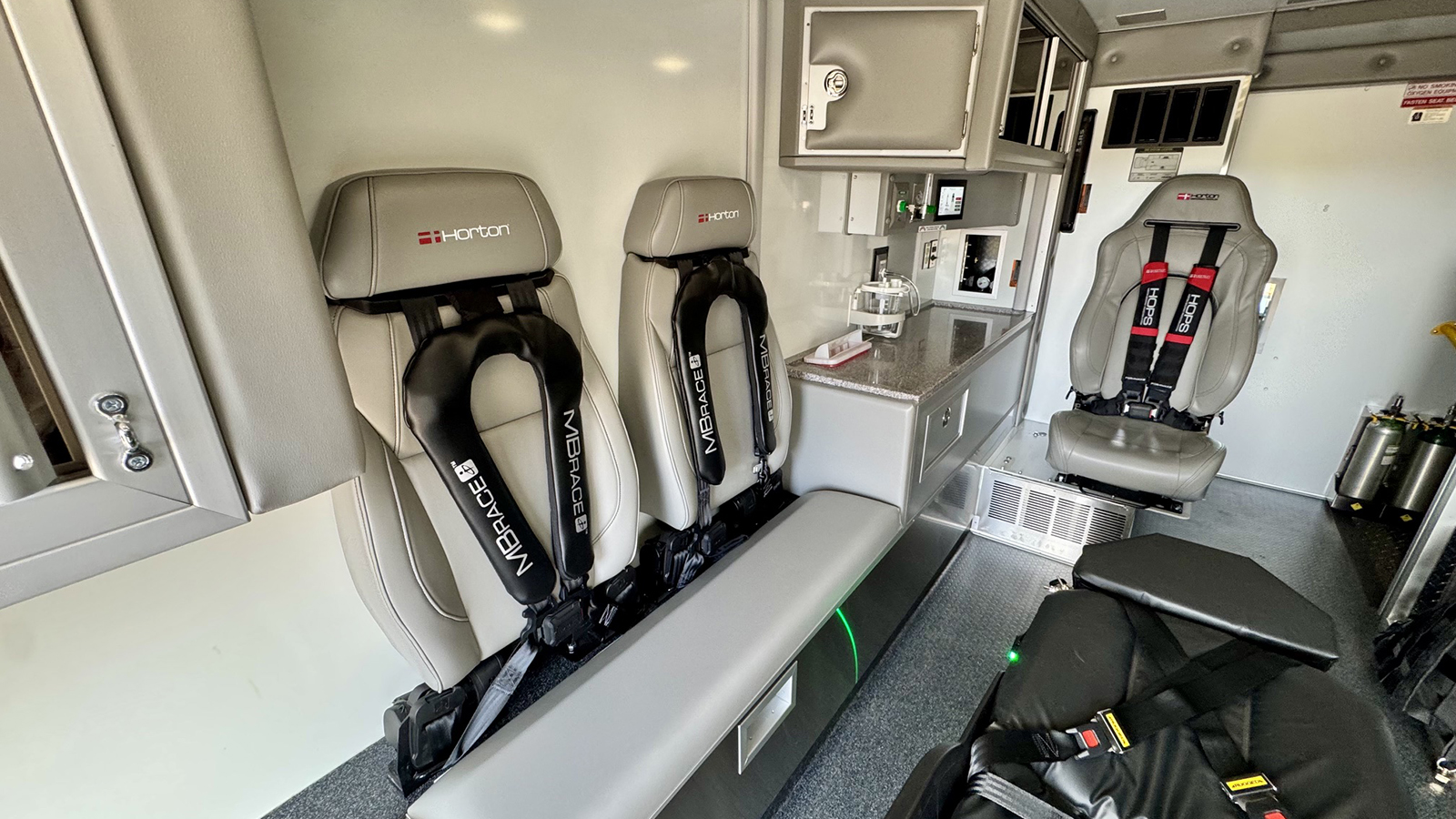
In a change from traditional CPR seating, the Superstition Type 1 has two seating positions in the CPR area.
Warren notes that the secondary AC system is running all the time in the station so it can keep the module cool prior to a call and also to power the mobile computer terminals, printers, models, and radios for instant use.
Warren adds that the new rig has a Stryker PowerLOAD system and Stryker PowerCOT, and that medics use automated Lucas CPR devices to do chest compressions on cardiac patients. It also has a product called Elegard to elevate a patient’s head during CPR. “Elegard positions the patient with an elevated head to provide the best profusion during CPR to get blood flow to the brain,” he says. “We are in the middle of a one-year study with this equipment and have seen a lot of positive results with more saves and more returns of rhythm and circulation than in the past.”
The new Type 1 for Superstition incorporates the Horton Occupant Protection System (HOPS), an industry-exclusive safety system engineered by Horton to protect EMS workers in the back of an ambulance during rollovers and frontal collisions, Marshall points out, integrating airbags directly into the harness to limit head and spinal movement.
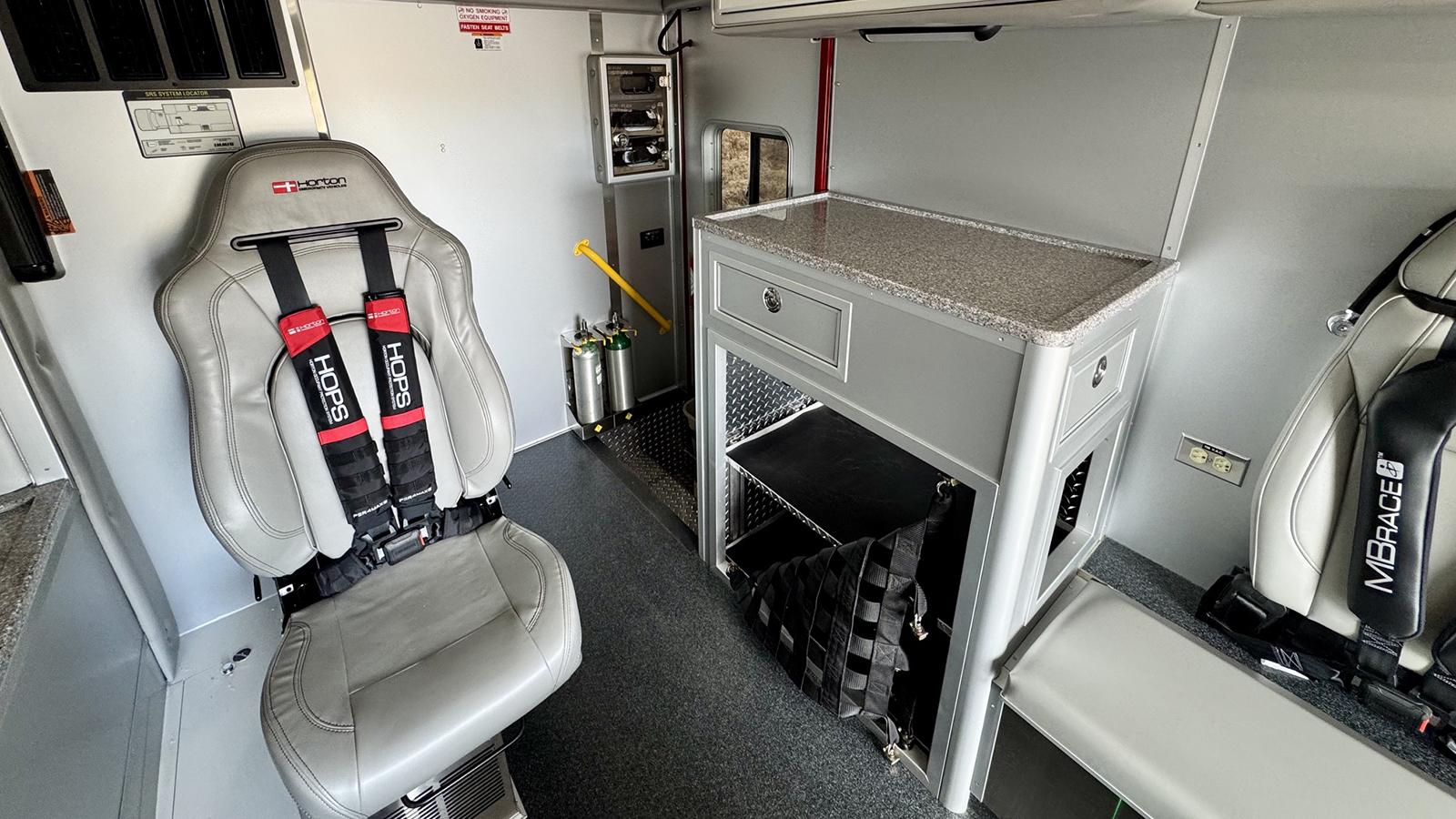
There’s a crash barrier at the head of the squad bench with netting over an inside/outside access compartment, and with a drawer on top only accessible from inside the box.
He says that core components of HOPS include the MBrace Integrated Harness Air bag, a safety innovation built in partnership with IMMI. “Unlike standard air bags, the air bag deploys from and wraps around the four-point harness, moving with the occupant to cradle the head and neck in both frontal impacts and rollovers,” Marshall notes.
The system also includes Per4Max four-point retractable harnesses to keep attendants firmly secured to their seat, preventing dangerous ejection or movement during a high-impact crash, and progressive foam insulation where all head-strike areas in the cabin are lined with multidensity, progressive foam to absorb impact energy, much like safety barrier walls on a racetrack.
Marshall says the HOPS and MBrace systems are standard on all new Horton Emergency Vehicles and are built directly into multiple seating positions, including the primary attendant seat, squad benches, and side-facing CPR seats. He adds that the Superstition rig has a total of five seating positions in the patient module including the attendant’s seat, two positions in the CPR area, and two positions on the curbside squad bench. “There’s also a crash barrier at the head of the squad bench with netting over an inside/outside access compartment, with a drawer on top only accessible from inside the box.
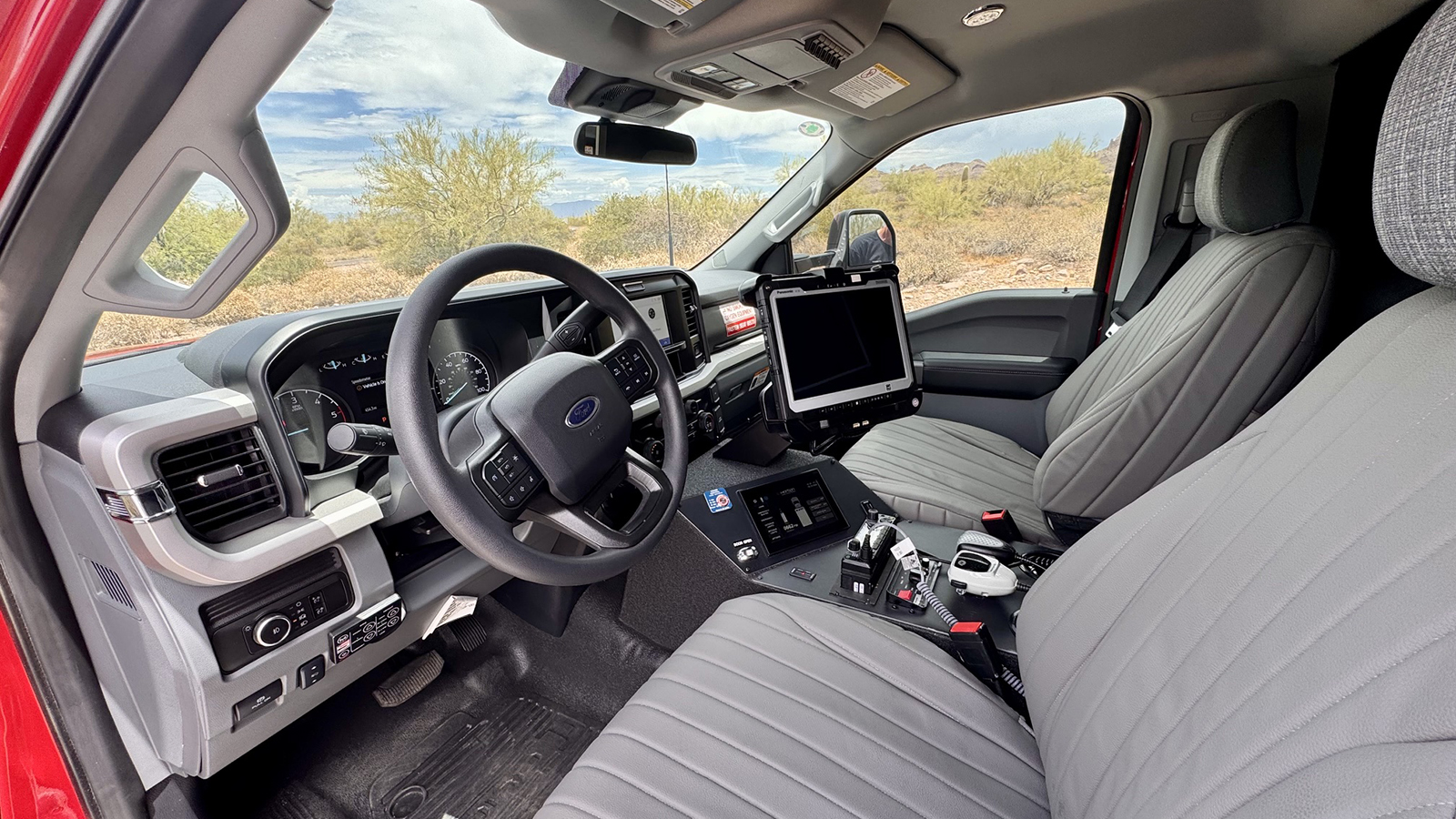
The cab on Superstition’s new Horton Type 1.
The Superstition Type 1 has Whelen M7 and M9 LED warning and scene lighting, a Tomar LED strobe light, red and amber LED chevron lighting, and a Whelen electronic siren.
ALAN M. PETRILLO is a Tucson, Arizona-based journalist who has served as a newspaper reporter, editor, and magazine writer and is a member of the Fire Apparatus & Emergency Equipment Advisory Board. He served 22 years with the Verdoy (NY) Fire Department, including in the position of chief.