By Alan M. Petrillo
Woodbury (MN) EMS and Fire runs four advanced life support (ALS) ambulances out of four stations, serving a population of 80,000 that swells by 10,000 during the daytime hours, with 31 paid full-time paid paramedics, a chief and fire marshal, and 13 paid part-time paramedics. Woodbury needed to upgrade a couple of its ambulances and chose to replace two Braun ALS rigs with two new Road Rescue Type 3 Ultramedic ALS units.
Val Huerta, director of EMS and fire command for Woodbury, says that when the replacement issue came up for two ambulances, the department checked out several brands and settled on the Road Rescue brand because the purchasing committee liked the design and layout of the rigs. “We wanted a gasoline engine on our new ambulances, and liked the bigger patient box on the Road Rescues compared to our previous Braun ambulances,” Huerta observes.
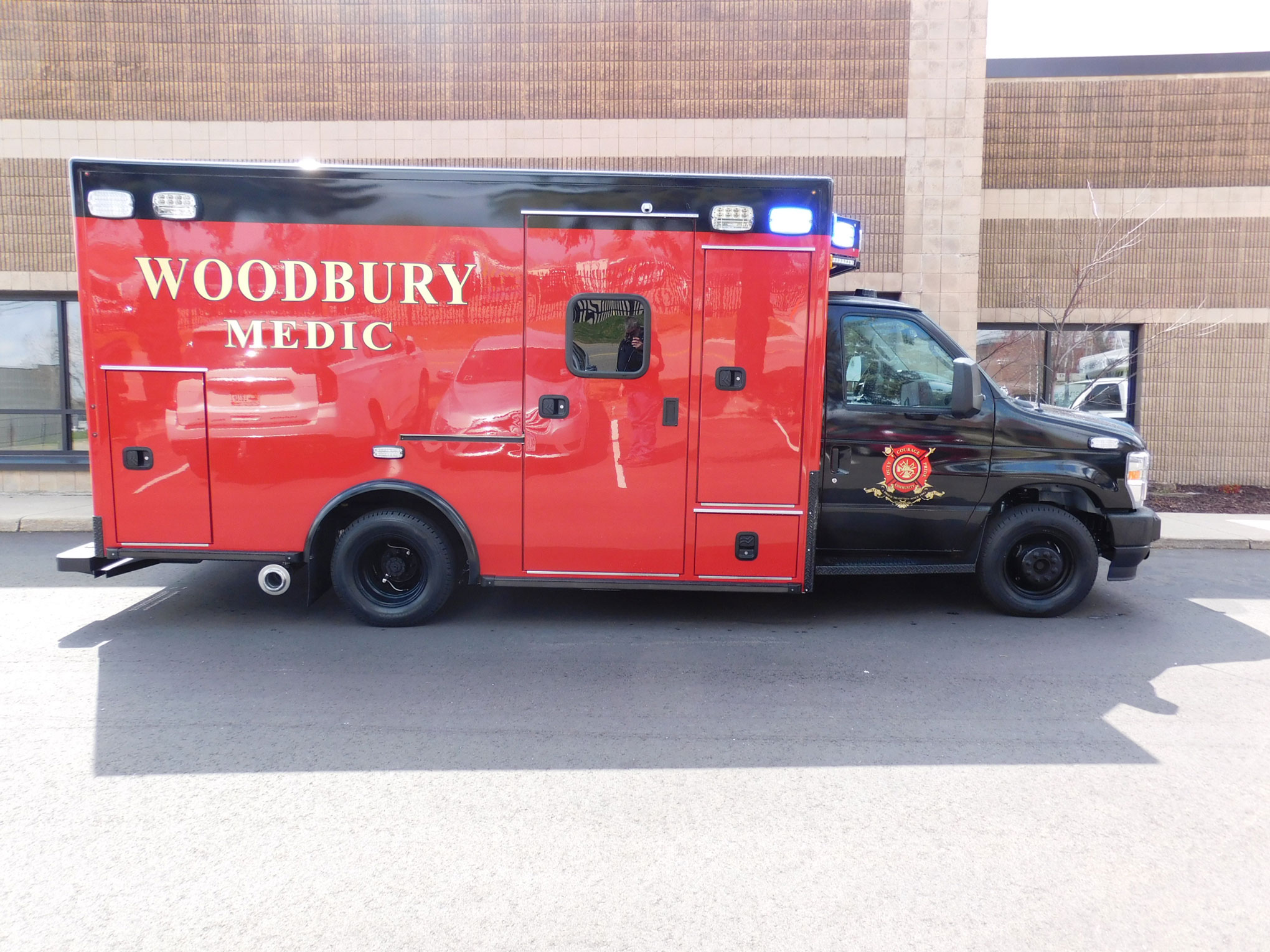
The Woodbury rigs have a 170-inch-long patient box that’s 96-inches-wide with 74 inches of headroom.
Holly Russell, brand manager for Road Rescue Emergency Vehicles, says the two new rigs for Woodbury EMS and Fire are built on Ford E-450 Ultramedic III cabs and chassis with a pass-through to the 170-inch-long patient box that’s 96-inches-wide with 74 inches of headroom, and has a 5-inch drop skirt on the street side, all powered by a 7.3-liter gasoline engine. She says the rigs have Kussmaul 20-amp auto eject ports with a mini indicator light on each side, and a Vanner Lifesine inverter.
Russell points out that the rigs have CoolBar 100,000 British thermal unit (Btu) air conditioning compressors on the front of the patient box, Velvac heated and electronically adjusted mirrors, two Buell air horns, curb side sliding doors instead of swinging doors, Safe Fleet multiplex electrical systems, and Brigade BlackEye 360 HD camera systems with 7-inch visual displays.
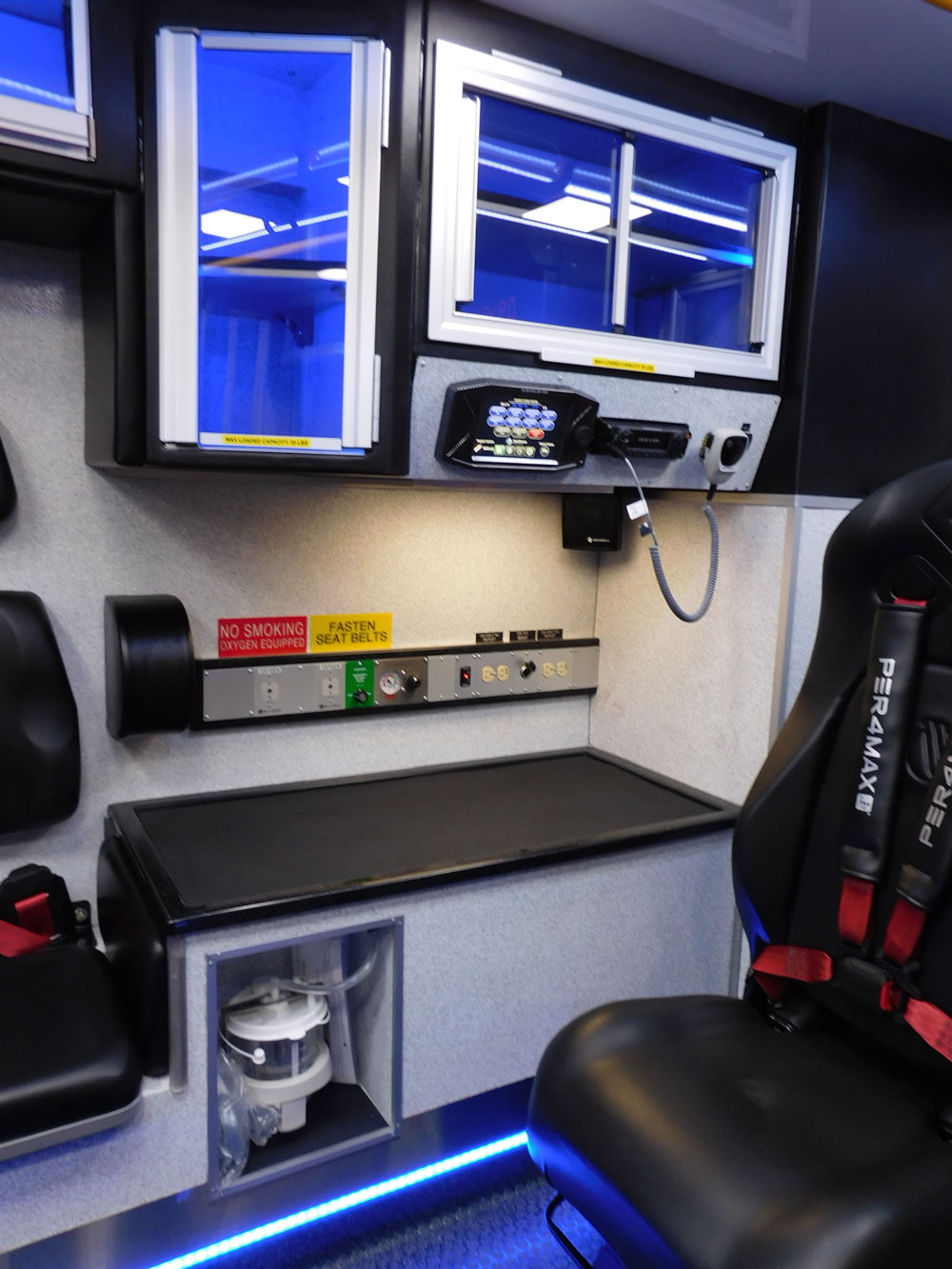
The action area to the right of the attendant’s seat.
Ross Taylor, sales manager for Everest Emergency Vehicles, who sold the two Road Rescues to Woodbury, says the department wanted more compartment space on the outside of the rigs that could handle not only its EMS equipment, but also its fire personal protective equipment (PPE). “Designing an ambulance to handle both those functions can be challenging,” Taylor observes, “so we took some design cues from other EMS/fire departments that run Road Rescue ambulances and put together a design that fit the needs of Woodbury EMS and Fire.”
Taylor points out that the Woodbury Road Rescue rigs have storage in the L1 compartment for O2 bottles, stair chairs and long backboards, while the L4 compartment has brackets for self-contained breathing apparatus (SCBA) air cylinders, and hooks for turnout coats and helmets. “The turnout gear is on the street side of the rigs,” he says, and that compartment also has power outlets for hand lights and thermal imaging cameras.”
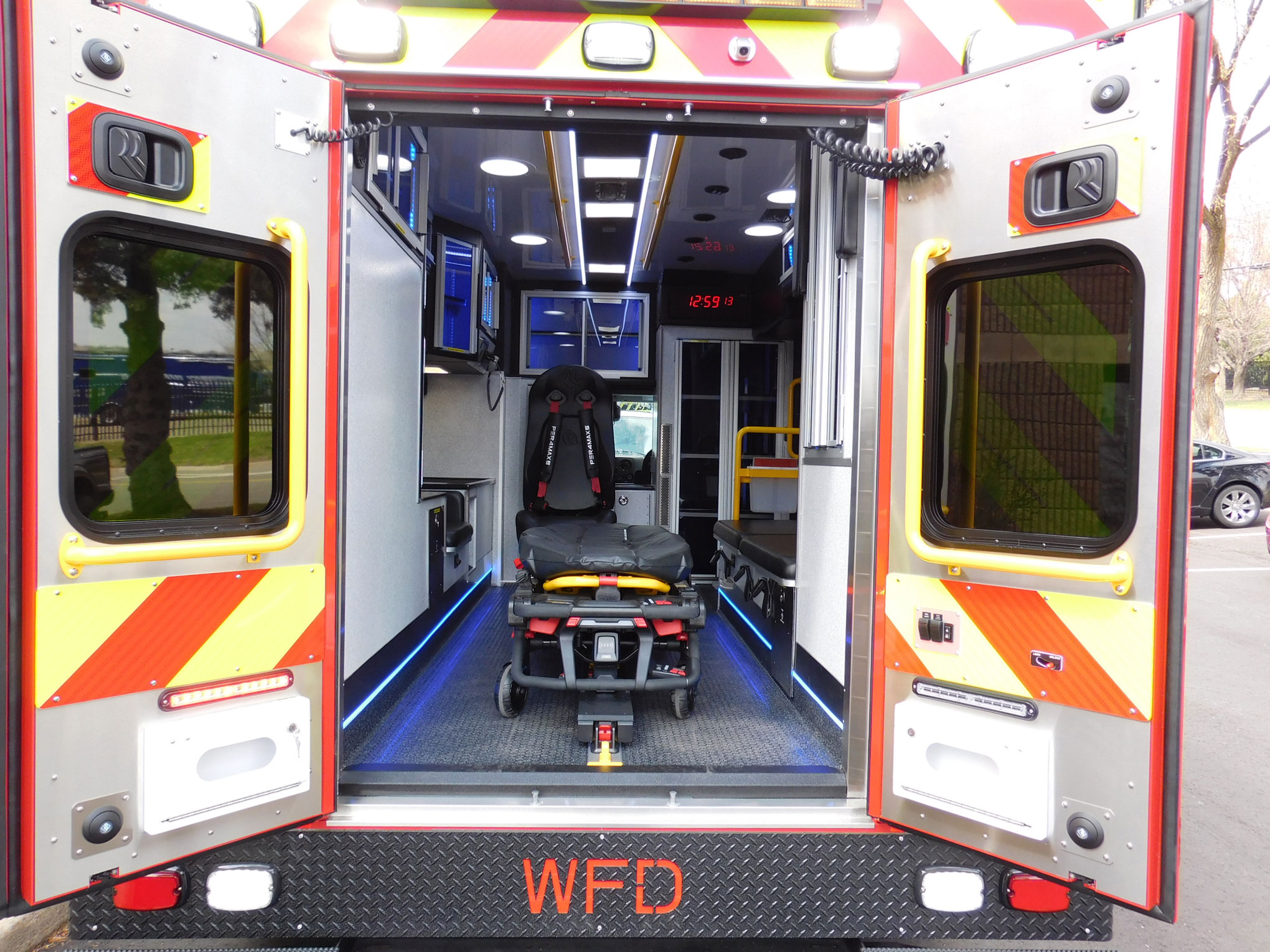
The new rigs have Stryker PowerLOAD and Power COT onboards.
He says the Ultramedics have dual seats on the squad bench, with an ALS stack of cabinets forward of the bench that has adjustable shelving and electrical outlets, and allows fast access to cardiac and IV equipment. Taylor notes that all seating positions in the ambulances are protected by Per4Max four-point harness systems.
Taylor says the Road Rescue Type 3 Ultramedic III rigs have four Whelen LED M9 and one M7 light on the top front of the patient box, HiViz FireTech LED mini brow lights, Whelen ION series LED warning lights, Whelen M7 and M9 LED scene lights, Tomar preemption traffic advisors, chevron LED lighting at the rear, blue LED floor lighting inside the patient box, LED cabinet lighting, and a Comfort Light 12-inch square dome light to disburse light more evenly so medics can more easily distinguish patient skin tones.
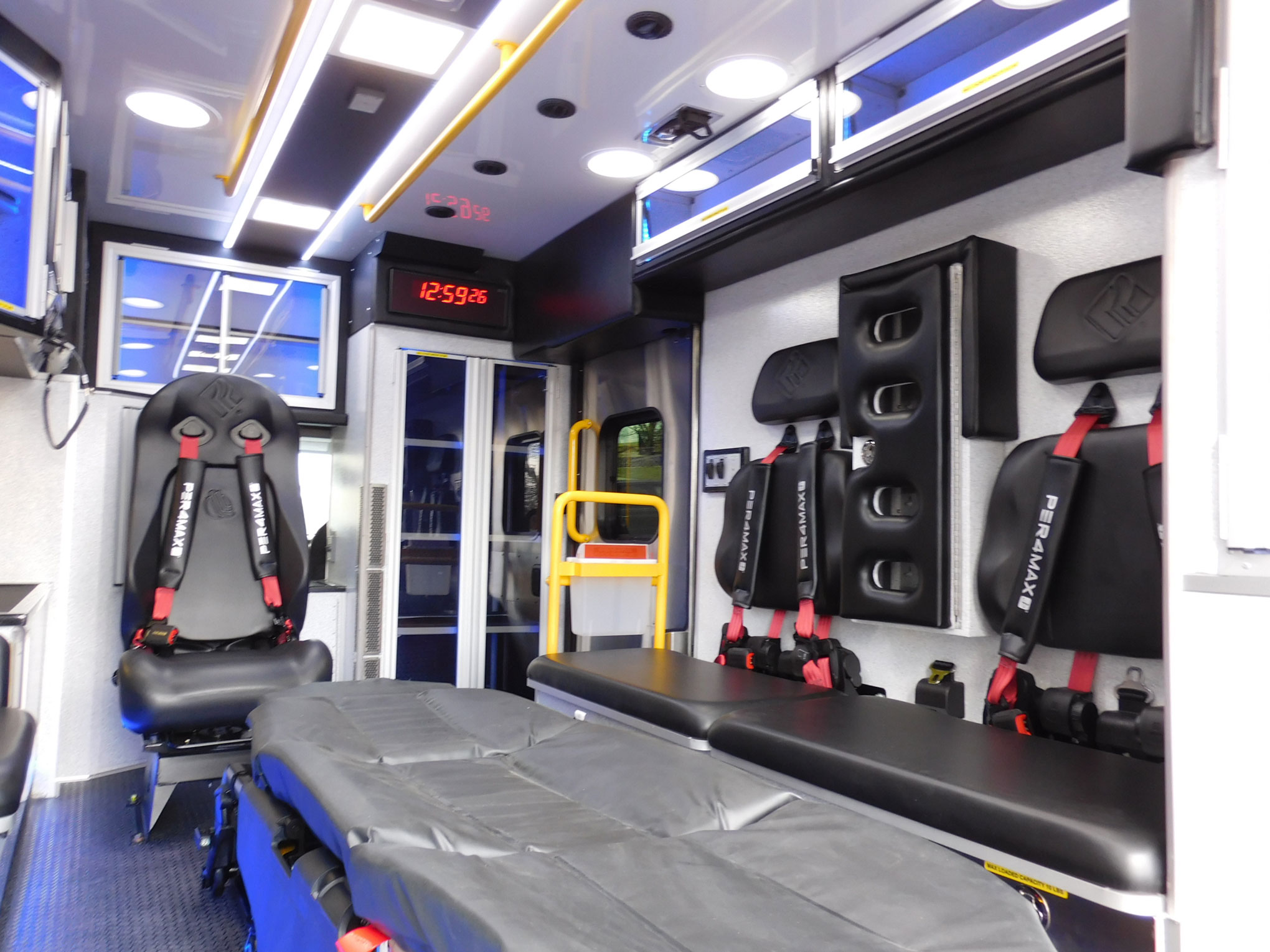
The new ambulances have dual seats on the squad bench. All four patient box seating positions are protected by Per4Max four point harnesses.
ALAN M. PETRILLO is a Tucson, Arizona-based journalist, the author of three novels and five nonfiction books, and a member of the Fire Apparatus & Emergency Equipment Editorial Advisory Board. He served 22 years with the Verdoy (NY) Fire Department, including in the position of chief.