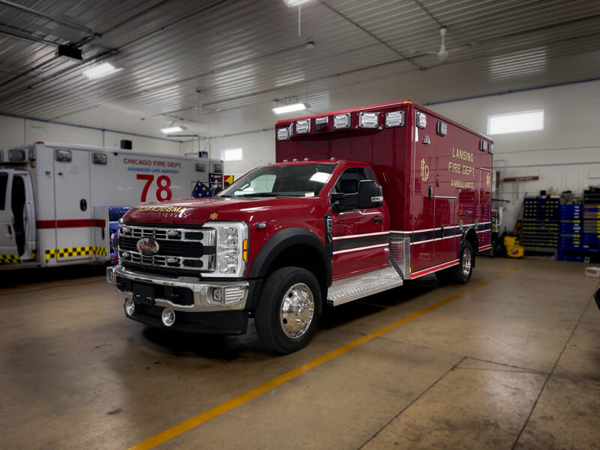
Wheeled Coach built this Type 1 ambulance on a Ford F-550 two-door cab and chassis for the Lansing (IL) Fire Department. (Photos 1-6 courtesy of Fire Service Inc.)
By Alan M. Petrillo
The Lansing (IL) Fire Department wanted to take an older ambulance and put it into reserve and get a new rig to run as a frontline response vehicle. The deputy chief says that the department’s medics were so pleased with the department’s prior purchase of a Wheeled Coach Type 1 ambulance, that they wanted another similar vehicle.
“Wheeled Coach is becoming our brand,” says John Grady, Lansing’s deputy chief. “Our medics are very satisfied with the truck and think it’s just what we’ve been looking for. They like the ease of access to the patient in the back of the rig, the good amount of operating space, and the way we have the interior cabinets set up.” Grady notes that the department is averaging 16 calls a day for 5,600 annual runs, with about 80% of them being emergency medical services (EMS) calls.
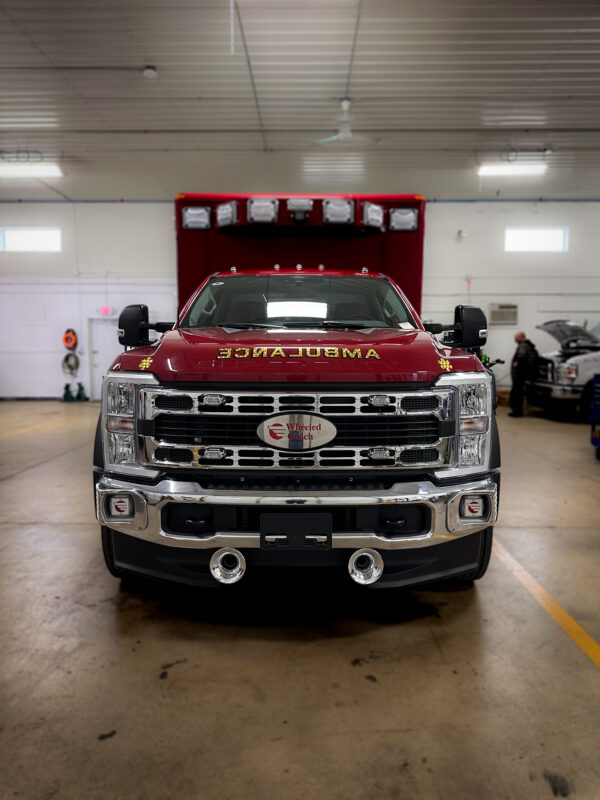
Lansing’s new rig has a CoolBar 100,000-btu condenser on the front of the box and a Turbo Air 2.0 system in the interior action area.
Greg DeForge, Wheeled Coach’s sales manager, says the rig built for Lansing Fire is on a Ford F-550 Type 1 two-door cab and chassis with a 193-inch wheelbase, a patient module that’s 170-inches long, 95-inches wide, and with a 9 foot 3 inch overall height, a 6.7-liter engine, and with a Vanner Lifesine inverter.
Josh Junker, Illinois territory sales representative for Fire Service Inc., who sold the Wheel Coach Type 1 to Lansing Fire, says the patient module has a pass-through to the vehicle’s cab, a CoolBar 100,000-British thermal unit (btu) condenser with four fans, and a TurboAir 2.0 system in the interior action area to cool the area near the EVS 1880 Comfort child/attendant safety seat.
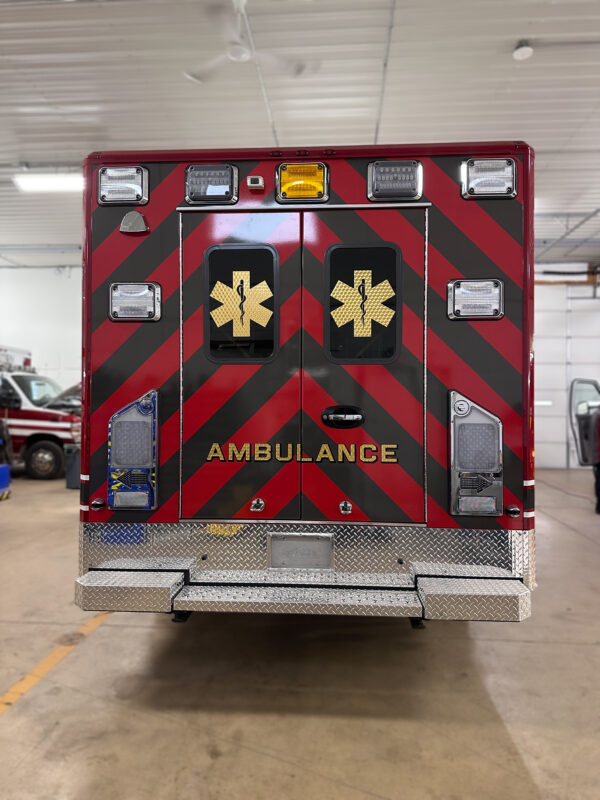
Emergency lighting on the Wheeled Coach Type 1 is comprised of Whelen 600 and 900 series warning and scene lights.
Junker points out that the Wheeled Coach interior has a refrigerator for pharmaceuticals that need cooling, lighting in all the cabinets, extra insulation for soundproofing in the body’s walls and ceiling, a Stryker PowerLOAD system, dual squad bench seating, and Per4Max 4-point seat harnesses on all four seating positions.
He says the rig has Whelen M6 LED grill lighting, Whelen 600 and 900 series warning and scene lighting, Whelen LED running road lights, LED strip lighting in all exterior compartments, and LED dome lighting in the patient box.
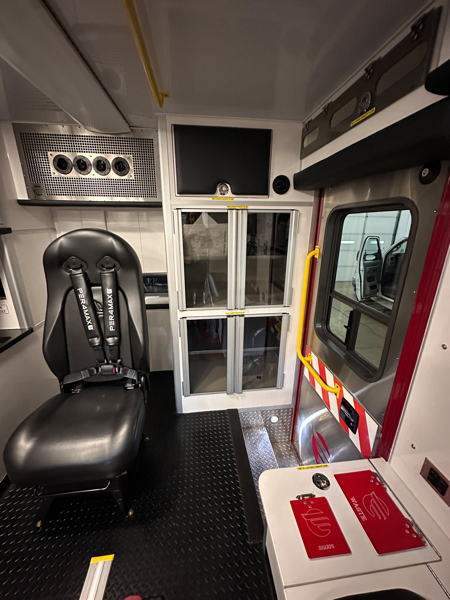
The rig has an EVS 1880 Comfort child/attendant safety seat at the head of the cot.
Lansing Chief Chad Kooyenga says that the department carries self-contained breathing apparatus (SCBA) and turnout gear in the L1 and L4 compartments for the two-person crew. “We didn’t want them cramped into a single compartment and having to gear up and get their SCBA on while bumping into each other,” he observes. “We went with the restocking cabinets on the interior of this rig, and are very happy with the CoolBar that keeps the patient box well cooled. The quality of the Wheeled Coach build is what keeps us coming back to them.”
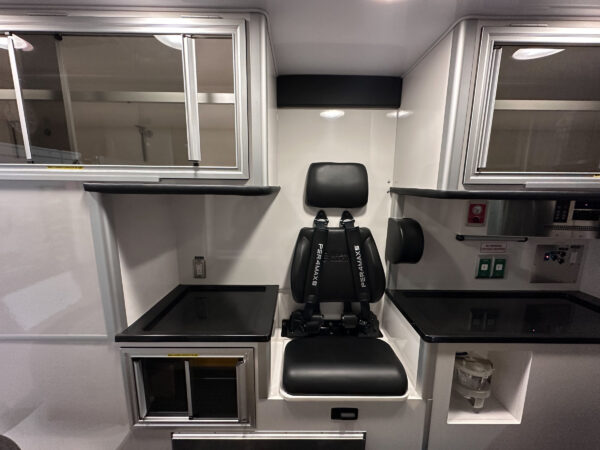
The CPR seat and the action area to its left.
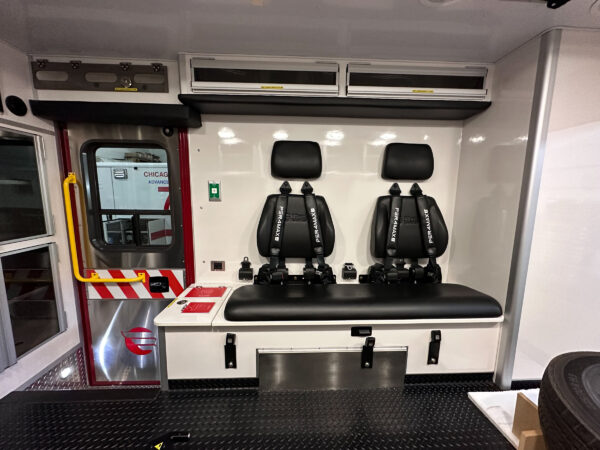
The squad bench has two seating positions. All seats in the back of the rig are protected by Per4Max four-point harnesses.
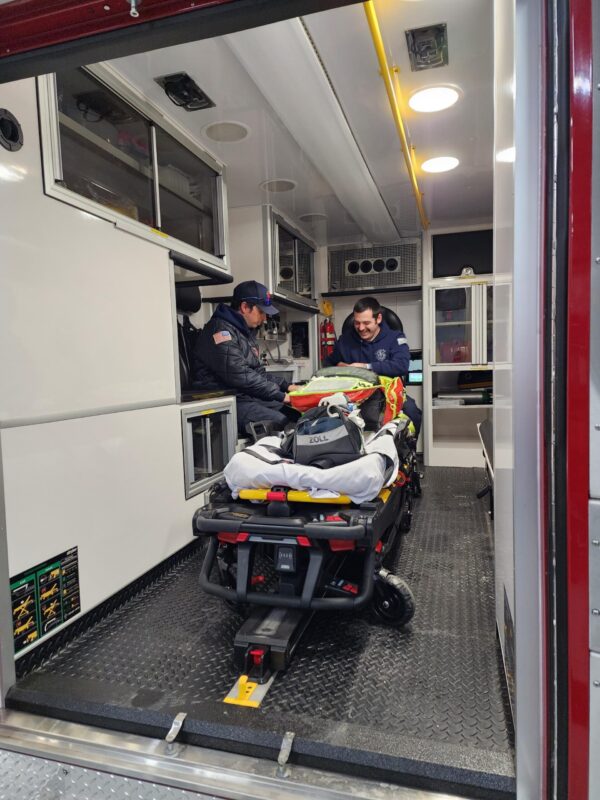
Lansing firefighter/medics secure the Stryker PowerLOAD cot in the rear of the rig. (Photo 7 courtesy of Lansing Fire Department)
ALAN M. PETRILLO is a Tucson, Arizona-based journalist, the author of three novels and five nonfiction books, and a member of the Fire Apparatus & Emergency Equipment Editorial Advisory Board. He served 22 years with the Verdoy (NY) Fire Department, including in the position of chief.