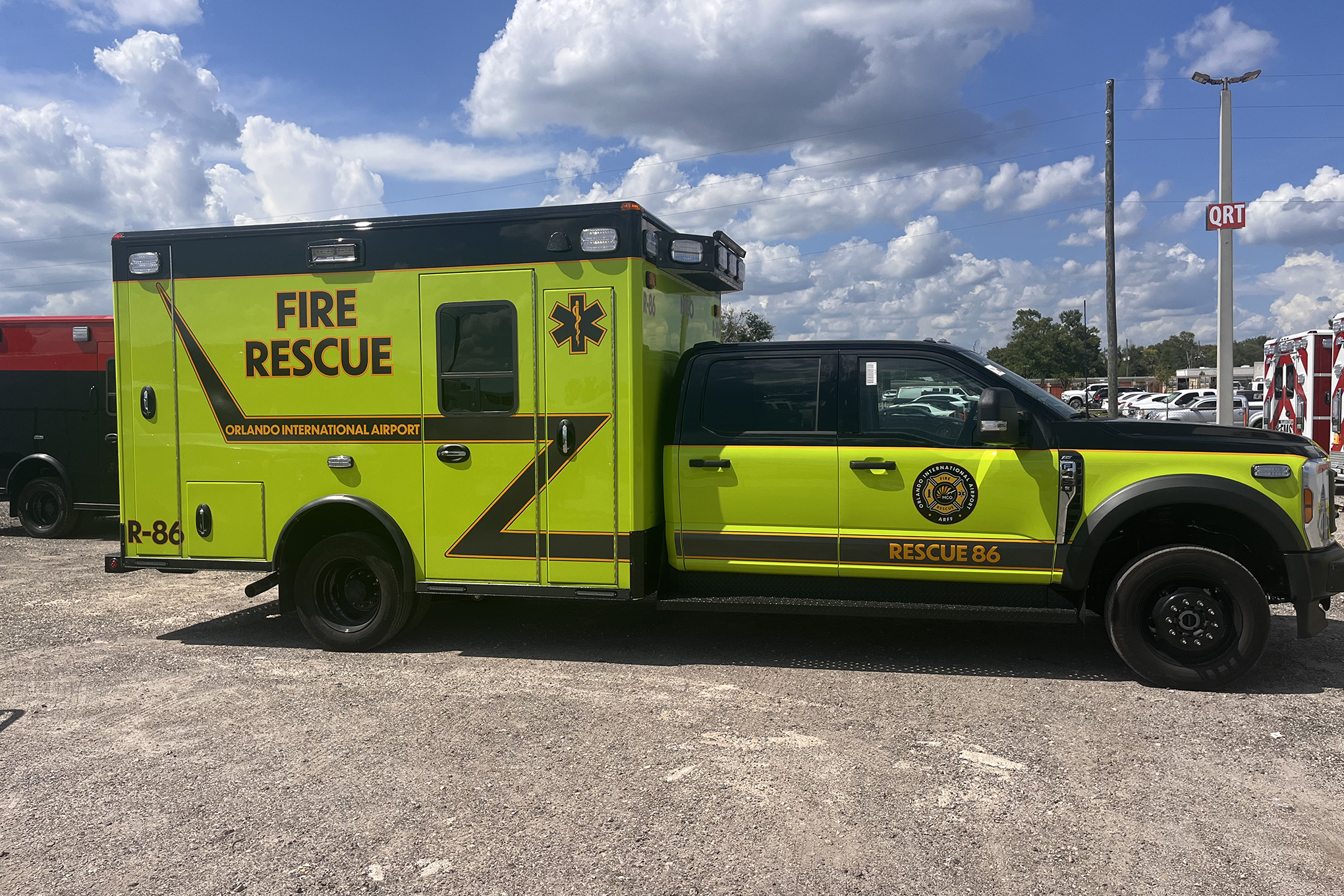
Wheeled Coach built this Type 1 ambulance on a Ford F-450 four door cab and 4×4 chassis for Orlando International Airport Fire Rescue. (Photos courtesy of Matheny Fire & Emergency.)
The Orlando International Airport is a busy place, a Federal Aviation Administration (FAA) Index E airport that maintains an emergency response 24/7/365. Orlando International Airport Fire Rescue currently runs five Rosenbauer Panther and Oshkosh Striker aircraft rescue and firefighting (ARFF) trucks, an engine company, a truck company, and three Wheeled Coach advanced life support (ALS) ambulances. Staffing is 96 firefighter/paramedics/emergency medical technicians (EMTs).
Randy Ramos, Orlando International Airport Fire Rescue lieutenant, says the department has to be concerned about the airport’s four runways, two on the East side of the airport and two on the West. “We have four fire stations, one station located in the center between the two sets of runways, one on the East side and another on the West side, while we just opened our fourth station outside the airport grounds near Jet Blue University, some hotels, and servicing hubs,” Ramos says.
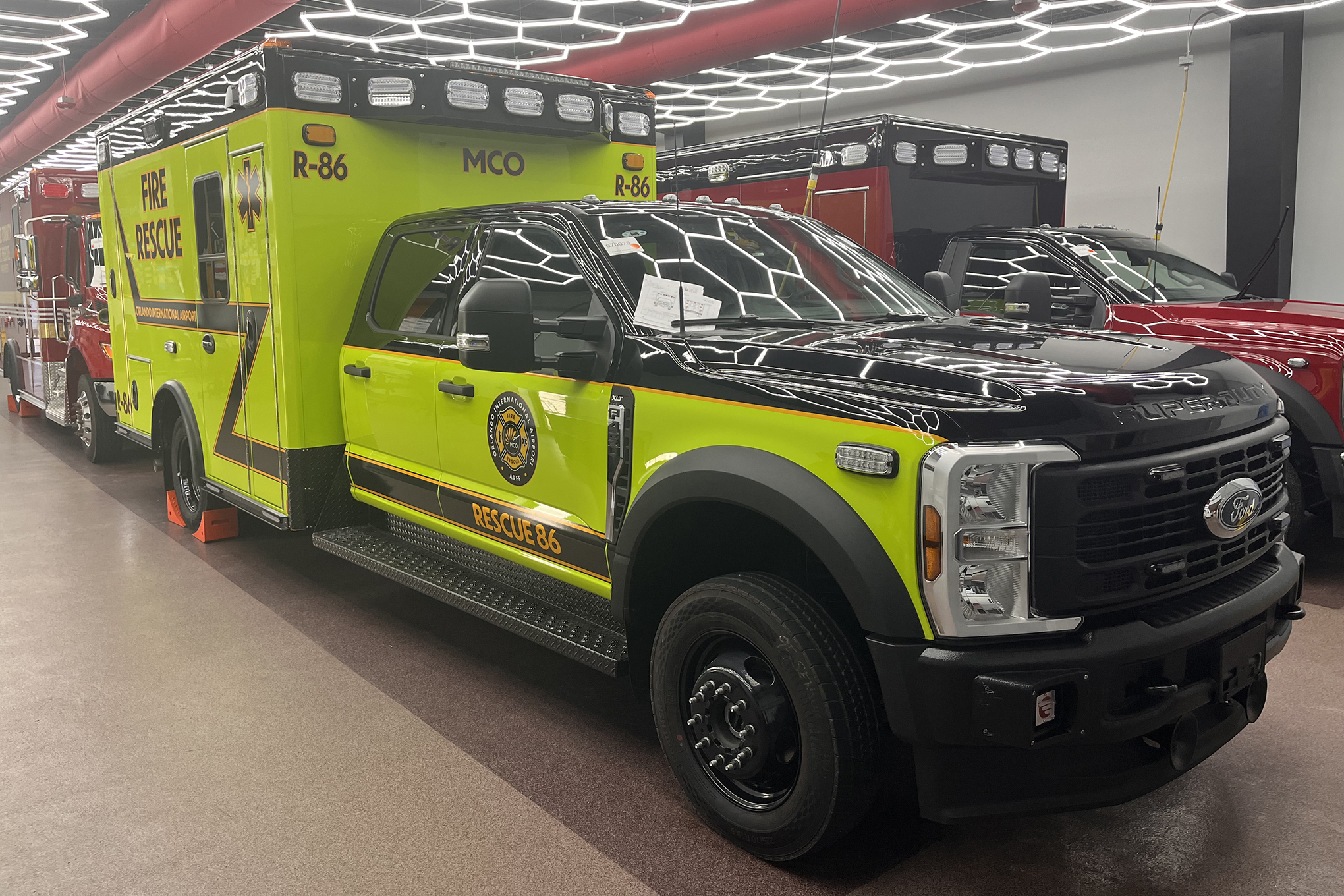
Lighting on the Wheeled Coach for Orlando Airport includes Whelen M9 LED warning lights, Whelen Pioneer LED scene lights, and a HiViz FireTech 35-inch LED brow light.
Because Orlando International Airport Fire Rescue runs three personnel on its ambulances, it chose a crew cab four-door format for its newest Wheeled Coach. “For EMS and other calls, we run two paramedics and one EMT on our ALS rigs, so we needed that crew cab for the third medic,” Ramos points out. Bill McCorkle, Florida territory sales manager for Matheny Fire & Emergency, who sold the unit, says the rig is built on a 2026 Ford F-450 four door cab and 4×4 chassis and is powered by a 6.7-liter V-8 diesel engine and an automatic transmission. “With the four-door cab, they chose to have the 153-inch body—96 inches wide, with 74 inches of headroom to accommodate their taller medics,” McCorkle says. McCorkle says the patient box was redesigned to to handle the turnout gear and self-contained breathing apparatus (SCBA) that Orlando Fire Rescue needs. He says the rig has space for two SCBA and two sets of turnout gear in the L4 compartment and a third SCBA and turnout gear in the compartment to the right side of the curbside entry door. Inside the patient module, Ramos points out that Orlando moved the location of the airway management chair (CPR chair). “We wanted it in line with the patient instead of being on the patient’s right shoulder,” he says. “So, we moved the seat toward the rear of the truck so the medic has better access to the patient.”
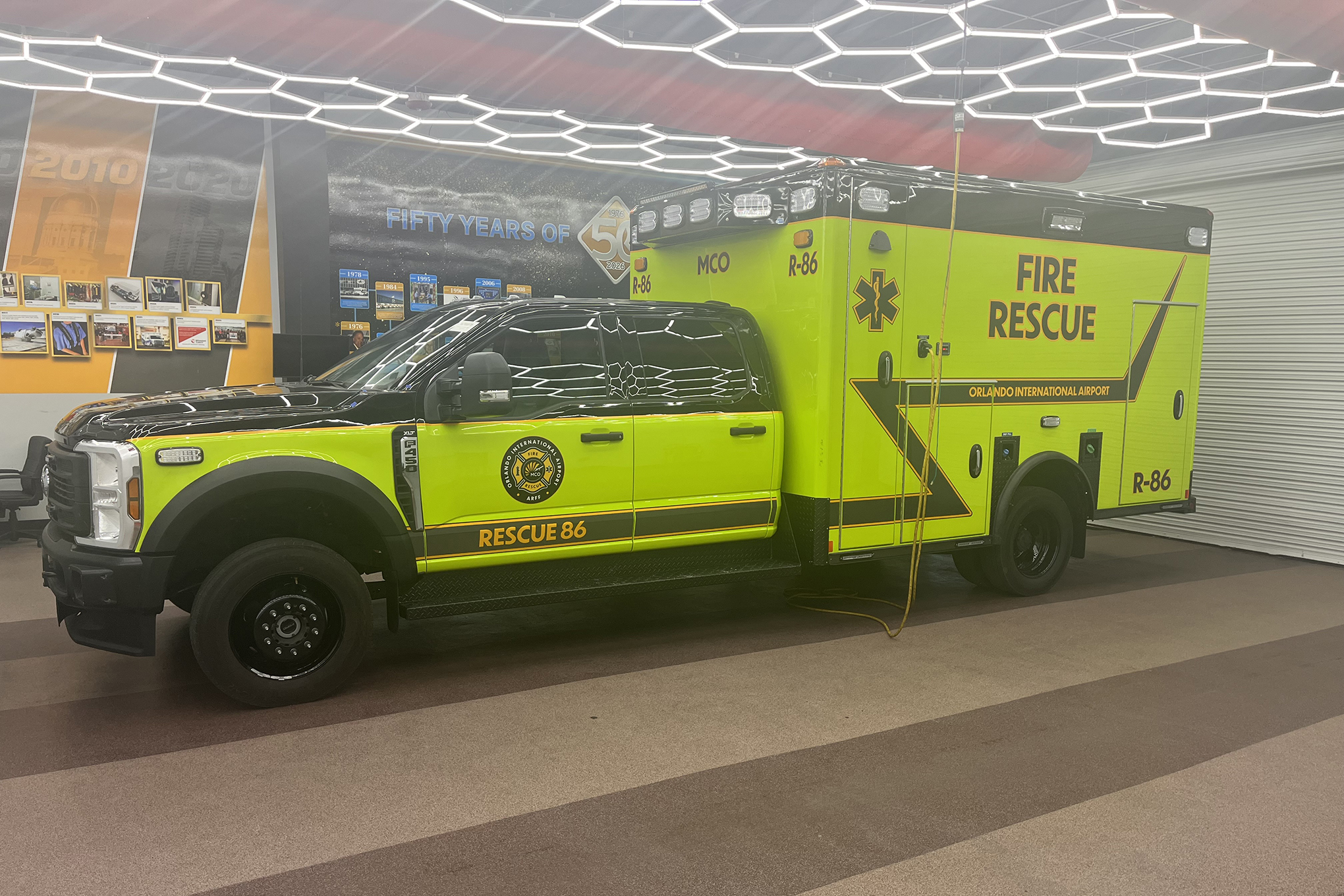
The Orlando Airport Fire Rescue rig is powered by a 6.7-liter V8 diesel engine and an automatic transmission.
McCorkle notes the ambulance has a 100,000-British thermal unit (Btu) CoolBar air conditioning condenser, a RelayPlex electrical system, Per4Max seatbelt harnesses on all seating positions, and an upgraded insulation package to help keep road noise from the patient box. Ramos adds that the squad bench has two seating positions and is long enough to accommodate a backboard should the need arise, and the rig carries a Stryker PowerLOAD system and a Stryker PowerCot. McCorkle says the rig’s lighting includes Whelen M9 LED warning lights, Whelen Pioneer LED scene lights, and a FireTech 35-inch LED brow light. ALAN M. PETRILLO is a Tucson, Arizona-based journalist who has served as a newspaper reporter, editor, and magazine writer and is a member of the Fire Apparatus & Emergency Equipment Advisory Board. He served 22 years with the Verdoy (NY) Fire Department, including in the position of chief.